CNC Machining for Industrial Components: Tolerances, Materials, and When to Use It
CNC machining delivers micron-level precision that casting and molding simply cannot match. This guide covers tolerances, material selection, surface finishes, and how to decide when CNC is the right process for your component.
CNC Machining for Industrial Components: Tolerances, Materials, and When to Use It
When a component needs to fit within ±0.01 mm, survive 10,000 operating cycles, or hold a mirror finish on a sealing surface, CNC machining is usually the answer. It is one of the most versatile subtractive manufacturing processes available — and one of the most misunderstood when it comes to cost and lead time.
This guide explains what CNC machining is, where it excels, how to specify it correctly, and how sourcing from Malaysia can cut your unit cost without sacrificing quality.
What Is CNC Machining?
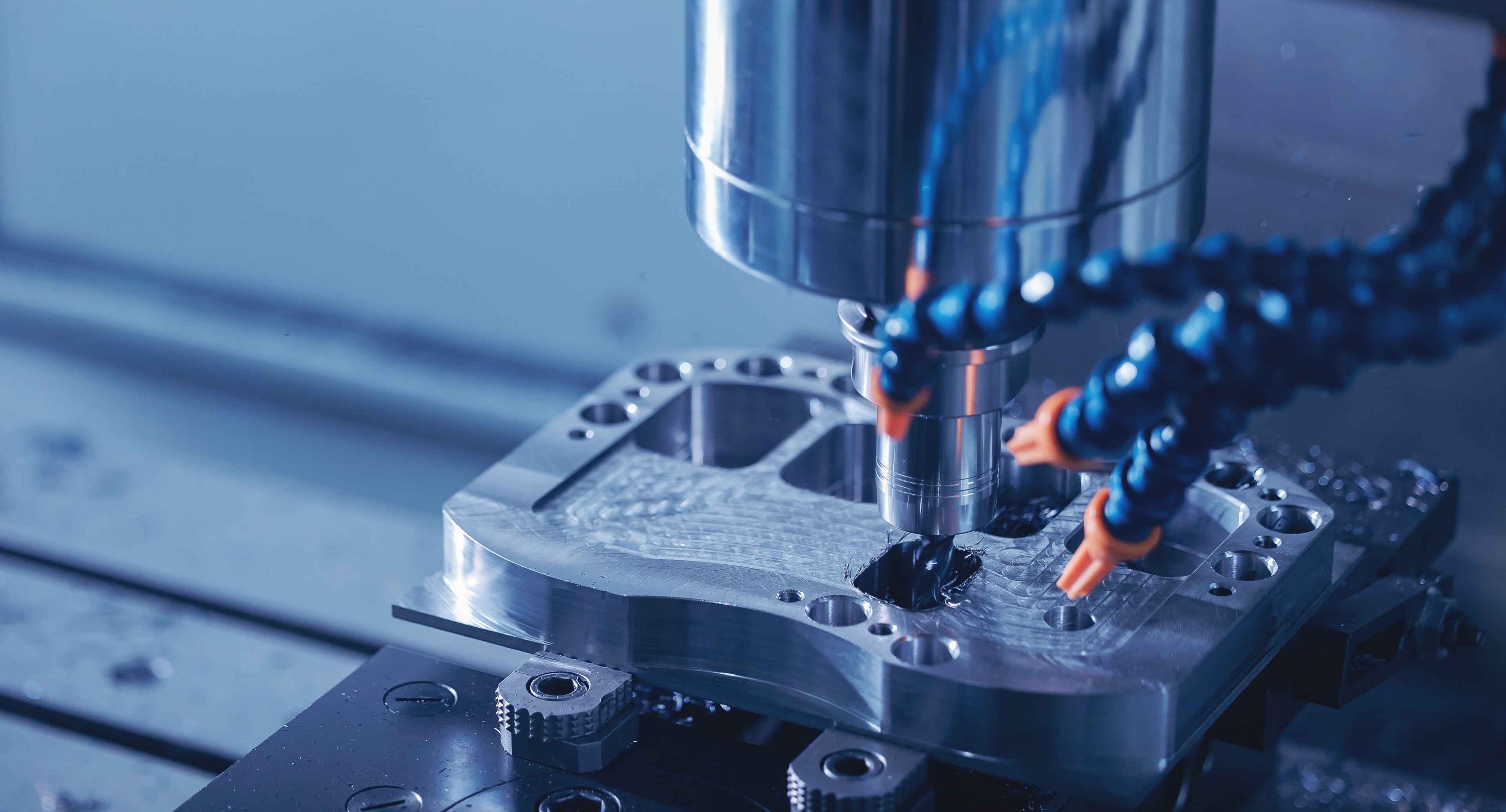
Computer Numerical Control (CNC) machining uses pre-programmed software to direct cutting tools — mills, lathes, drills, grinders — across a workpiece with sub-millimetre precision. The machine reads a G-code file derived from your CAD model and removes material until the finished geometry is achieved.
Modern CNC centres are 3-axis, 4-axis, or 5-axis. Five-axis machines can tilt and rotate the workpiece continuously, allowing complex undercuts, compound angles, and organic surfaces to be cut in a single setup — reducing fixturing time and improving geometric accuracy.
Tolerances: What CNC Can Actually Hold
Tolerance capability depends on the machine, the material, and the feature type. As a practical guide:
| Feature | Typical Tolerance | Achievable with Care |
|---|---|---|
| Linear dimensions | ±0.05 mm | ±0.01 mm |
| Hole diameter (reamed) | ±0.025 mm | ±0.005 mm |
| Surface flatness | 0.05 mm/100 mm | 0.01 mm/100 mm |
| Surface roughness (Ra) | 1.6 µm | 0.4 µm (ground) |
| Thread pitch diameter | ISO 6H/6g | ISO 4H/4g |
For reference, a human hair is approximately 70 µm in diameter. Holding ±0.01 mm means your tolerance band is roughly one-seventh of a hair — achievable on a well-maintained machining centre with the right fixturing and tooling.
Key rule: tighter tolerances cost more. Every feature tightened beyond ±0.05 mm adds inspection time, slows feed rates, and may require a secondary grinding or honing operation. Only specify tight tolerances where they are functionally necessary.
Material Selection
CNC machining works on virtually any solid material. The most common choices for industrial components:
Aluminium Alloys
6061-T6 is the workhorse — excellent machinability, good strength-to-weight ratio, and natural corrosion resistance. 7075-T6 offers higher strength for aerospace and structural applications. Aluminium machines quickly, which keeps cycle times and costs low.
Stainless Steel
304 and 316 are the standard grades. Both work-harden during cutting, so tooling selection and cutting parameters matter. 316 adds molybdenum for superior corrosion resistance in marine and chemical environments. Expect machining costs roughly 2–3× higher than aluminium.
Carbon and Alloy Steel
1045, 4140, and 4340 cover most structural and mechanical applications. These machine well and respond to heat treatment, allowing you to machine in the annealed state and harden afterwards. Ideal for shafts, gears, and load-bearing brackets.
Titanium
Grade 5 (Ti-6Al-4V) is the standard aerospace and medical grade. Excellent strength-to-weight ratio and biocompatibility, but poor thermal conductivity means heat concentrates at the cutting edge. Machining costs are 5–8× aluminium. Use only where weight or biocompatibility is a hard requirement.
Engineering Plastics
Delrin (POM), PEEK, Nylon, and UHMWPE all machine cleanly. Plastics are used for bearing surfaces, electrical insulators, and food-contact components. Dimensional stability after machining can be an issue — allow parts to stabilise before final inspection.
Surface Finishes
The as-machined surface finish (Ra 1.6–3.2 µm) is acceptable for most structural and non-sealing applications. Common secondary finishes:
- Anodising (aluminium): Type II (decorative, 5–25 µm) or Type III hard anodise (wear-resistant, 25–75 µm). Adds corrosion resistance and can be dyed.
- Electroless nickel plating: Uniform coating regardless of geometry. Good for corrosion and wear resistance on steel and aluminium.
- Black oxide: Mild corrosion resistance, low cost, minimal dimensional change. Common on steel fasteners and fixtures.
- Passivation (stainless steel): Removes free iron from the surface, restoring the chromium oxide passive layer after machining.
- Bead blasting: Produces a uniform matte finish. Often used before anodising for a consistent appearance.
- Polishing: Ra 0.4 µm or better for optical, sealing, or aesthetic surfaces.
When to Choose CNC Over Casting or Molding
CNC machining is the right choice when:
Volumes are low to medium. Tooling for die casting or injection molding costs RM 15,000–150,000. CNC requires no tooling investment — you pay per part. For quantities below roughly 500–1,000 units, CNC is almost always more economical.
Tolerances are tight. Casting and molding introduce shrinkage, warpage, and draft angles that limit achievable tolerances. CNC starts from solid stock and cuts to dimension.
Material properties are critical. You need wrought (not cast) material properties — higher tensile strength, better fatigue resistance, finer grain structure. A machined 7075-T6 aluminium bracket is significantly stronger than a die-cast A380 equivalent. See our die casting buyer's guide for a detailed process comparison.
Geometry changes are likely. Design iterations are free — just update the CAD file and re-run. With casting or molding, every design change means modifying or scrapping expensive tooling.
Lead time is short. A CNC part can be quoted, programmed, and shipped within days. Die casting tooling takes 4–8 weeks minimum.
Design for Manufacturability (DFM) Tips
Getting DFM right at the design stage saves significant cost:
Avoid deep, narrow pockets. The depth-to-width ratio of a pocket should not exceed 4:1. Deeper pockets require longer tools, which deflect and chatter, degrading surface finish and tolerance.
Specify radii on internal corners. Sharp internal corners are impossible to machine with a rotating cutter. The minimum internal radius equals the cutter radius — typically 0.5–3 mm. Design your corners with a radius and call it out on the drawing.
Minimise setups. Every time a part is re-fixtured, there is a risk of datum shift. Design parts so that all critical features can be machined from one or two setups.
Avoid thin walls. Walls thinner than 0.8 mm in metal (1.5 mm in plastic) will vibrate during cutting, causing chatter marks and dimensional variation. If thin walls are unavoidable, discuss fixturing strategies with your manufacturer.
Thread depth. For threaded holes, a depth of 1.5× the nominal diameter is sufficient for most applications. Deeper threads add cycle time without meaningfully increasing pull-out strength.
CNC Machining in Malaysia: The Cost Advantage
Malaysia's manufacturing ecosystem — particularly in Johor and the Klang Valley — offers a compelling combination of skilled machinists, modern 5-axis equipment, and labour costs 60–70% lower than Western Europe or North America. Learn more about why global brands choose Malaysia for precision manufacturing.
Keiteq Direct operates multi-axis CNC machining centres capable of holding ±0.01 mm tolerances across aluminium, steel, stainless, and engineering plastics. Our in-house CMM inspection ensures every batch ships with full dimensional reports. We also offer mold fabrication for customers who need both tooling and machined components from a single partner.
For overseas buyers, we offer:
- DFM review within 24 hours of receiving your CAD files
- Competitive per-part pricing with no minimum order quantity for prototypes
- ISO 9001:2015 and IATF 16949 quality management
- Sea and air freight coordination from Port of Tanjung Pelepas
Learn more about Keiteq Direct's capabilities and 45-year manufacturing heritage →
Getting Started
The fastest way to get a quote is to send us your STEP or IGES file along with a PDF drawing showing critical tolerances, surface finish requirements, and material specification. We will return a DFM review and quotation within one business day.
Explore Topics
Written by
Keiteq Direct Engineering Team
Content creator and writer sharing insights and stories.


